1Work in pairs. Discuss the statements. Do you agree or disagree?
1 Hot and sunny weather is much better than cold, snowy weather.
Your opinion
2 Sometimes it's nice to have a rainy day.
Your opinion
3 The weather affects people's mood.
Your opinion
4 The weather in the different seasons is changing.
Your opinion
2Work in pairs. Look at the photos and describe the weather in each place.
Photo A
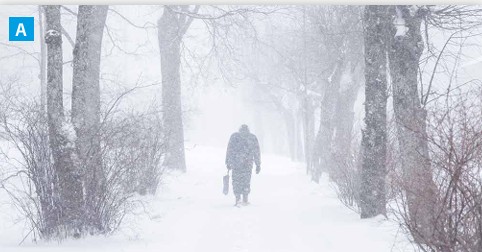
Photo B
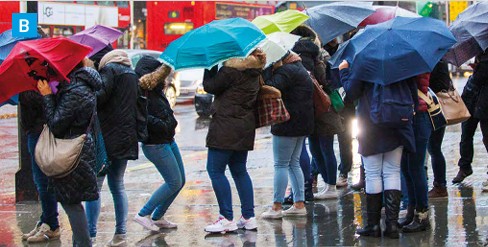
Photo C

Photo D
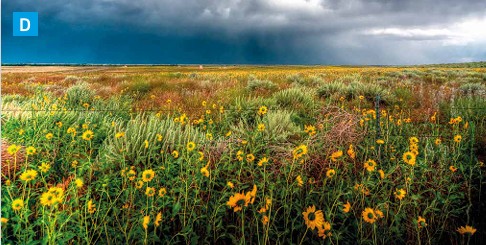
Describe each photo with your partner. Click Show hint to check suggested weather vocabulary.
3Match words 1–6 with their collocations a–f.
Click a word (left), then click its collocation (right).
Matched: 0 / 6
4Read the text and decide if the statements are True (T) or False (F).
⛅ Forecasts Through the Years
Before breakthroughs in modern weather forecasting technology, the weather was predicted in many different and unusual ways. In the past, animal behaviour was most often used to predict the weather for the coming week. For example, people noticed that spiders were more likely to spin stronger and thicker webs when a storm was coming, and that when cows stood close together there was a good chance of rain. Birds flying low showed that the air pressure was low, signalling a possible rainstorm. Other natural phenomena used to predict the weather included the shape and colour of the clouds, looking at the direction the wind was blowing the grass in the fields, and smelling the air to determine the air pressure.Things began to change between 1400 and 1700, when some simple weather tools were invented. People also began to record weather information from past years and seasons and analyse it to predict what was likely to come the next year.
Nowadays, we're able to access weather forecasts at any time of day from anywhere around the world — by listening to weather reports on the radio, downloading weather apps, or reading forecasts in the newspapers. Weather stations run by the WMO are located at all airports.
5Watch the video from 01:18–02:04. Tick the words you hear.
6Now watch the video from 01:23–02:01. Number the sentences in the order you hear them.
Some places will have a better day tomorrow.
That one shows the amount of cloud.
That's the rain.
Well this shows the different elements of the weather.
The rain pushes right across the country.
That one there shows the wind speed and wind direction.
As the rain starts to move away, we should get some sunshine.
7aRead the weather forecast from the video. Complete the sentences with the phrases in the box.
likely to
probably won't
that's likely to be
there's going to be
will probably
Good evening, well the weather over the last few days hasn't been great and ahead it's looking like
1
be heavy showers and a chilly wind. Now if you look at the satellite you can see the huge amount of cloud that's covering the country and that is
2
bring rain.
So, let's start with tonight, well the blue, that's the rain, and 3 coming down the country so it 4 rain tonight, and you 5 see any sunshine. Sorry about that, that's it for now. Goodnight.
So, let's start with tonight, well the blue, that's the rain, and 3 coming down the country so it 4 rain tonight, and you 5 see any sunshine. Sorry about that, that's it for now. Goodnight.
8aWatch the whole video again. Were these things done by Liam or Sally? Type the name.
1. explained the information on the screens.
2. asks some questions about the computer screens.
3. make the computer graphics for the weather forecast.
4. The producer gives a microphone to wear.
5. presents the weather forecast on TV.
8bRe-write the sentences in Exercise 8a using the passive form.
1. Liam explained the information on the screen.
2. Sally asked some questions about the computer screens.
3. Liam and Sally made the computer graphics for the weather forecast.
4. The producer gave Sally a microphone to wear.
5. Sally presented the weather forecast on TV.
💡 Model answers:
1. The information on the screen was explained by Liam. · 2. Some questions were asked about the computer screens by Sally. · 3. The computer graphics for the weather forecast were made by Liam and Sally. · 4. Sally was given a microphone to wear by the producer. · 5. The weather forecast was presented by Sally.
1. The information on the screen was explained by Liam. · 2. Some questions were asked about the computer screens by Sally. · 3. The computer graphics for the weather forecast were made by Liam and Sally. · 4. Sally was given a microphone to wear by the producer. · 5. The weather forecast was presented by Sally.
9Work in pairs. Discuss the questions.
1Do you think Sally did a good job of presenting the weather? Why/Why not?
2What would be difficult about doing this job?
3Where do you normally get information about the weather?
4Is the weather forecast you use mostly accurate?
10Work in pairs. Make predictions about the weather in the situations below. Use the phrases from Exercise 7a.
there's going to be
likely to
that's likely to be
will probably
probably won't
aThe weather in your country in July
bThe weather tomorrow
cGlobal temperatures in 10 years
dGlobal temperatures in 100 years
A: In my country, it will probably be hot in July. It always is!
B: In my country, there's likely to be showers. We don't have much of a summer!
B: In my country, there's likely to be showers. We don't have much of a summer!