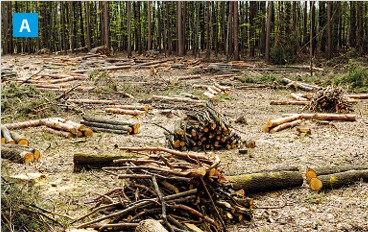
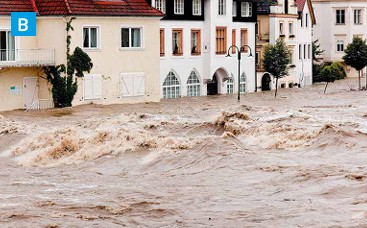
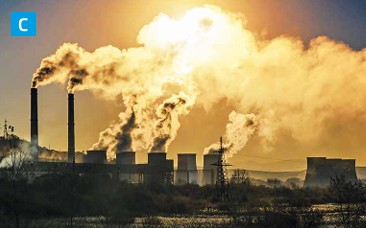
1Work in pairs. Look at the photos and discuss the questions.
 A
A
 B
B
 C
C
1What environmental problems can you see in the photos?
2What do you know about these environmental issues?
3What long-term effects could they cause in the future?
4What other environmental issues are affecting our world at the moment?
2Work in pairs. Read the statements below. Tell your partner if you agree or disagree and give reasons.
a The Earth has become warmer over the last 30 years.
Your opinion
b People ought to stop clearing land to build new houses.
Your opinion
c People should try to grow more of their own food.
Your opinion
3Read the text and answer the questions.
🌿 SOS Wildlife
From tigers to pandas, spiders to sharks, many of Earth's unique and beautiful animals are now in danger of disappearing from our planet. Wildlife is at risk all over the world because of human actions, but what can we do to save it?Many experts believe the answer is in education. Schools in some countries are now required to teach children about environmental issues and ways to resolve them, as part of their national curriculum. One important topic is looking at alternative ways of feeding the human population. We need to stop destroying wild habitats to use the land for agriculture. Many schools have outdoor green spaces where students can learn how to take care of their own garden and grow fruit and vegetables and the younger generation is now putting more pressure on governments to introduce laws to stop the destruction of forest habitats.
Another major issue for wildlife, particularly marine animals, is plastics pollution. Thanks to programmes to increase awareness about this problem in the media, the number of people using single-use plastics has fallen dramatically, and people have started to use more environmentally-friendly products instead.
1. Why is world wildlife at risk, according to the text?
2. What are schools in some countries now required to do?
3. Why are people destroying habitats, according to the text?
4. How are schools teaching students about other ways to feed the human population?
5. What is another major issue for animals and plants that live in the sea?
6. What has happened to the number of people using single-use plastics?
💡 Model answers:
1. Because of human actions · 2. To teach children about environmental issues and ways to resolve them · 3. To use the land for agriculture · 4. Schools have outdoor green spaces where students can learn how to grow fruit and vegetables · 5. Plastics pollution · 6. The number has fallen dramatically
1. Because of human actions · 2. To teach children about environmental issues and ways to resolve them · 3. To use the land for agriculture · 4. Schools have outdoor green spaces where students can learn how to grow fruit and vegetables · 5. Plastics pollution · 6. The number has fallen dramatically
4Watch the video from 00:14–00:57. Complete Sally's introduction with the words in the box.
beeplanetplants
problemwarmingwildfires
Hi, it's Sally Williams, your Roadmap reporter here. Every day we hear stories from around the world about environmental disasters like
1
or flooding due to global
2 .
And there are other threats to the 3 that are less visible but just as serious like the disappearing of some 4 populations. Bees play an important role in providing the food we eat. They spread pollen, and without this, many 5 would die off, and that would have a big impact on the entire food chain. So today, I've come to Mudchute Farm in London to meet a man who's trying to solve this environmental 6 .
And there are other threats to the 3 that are less visible but just as serious like the disappearing of some 4 populations. Bees play an important role in providing the food we eat. They spread pollen, and without this, many 5 would die off, and that would have a big impact on the entire food chain. So today, I've come to Mudchute Farm in London to meet a man who's trying to solve this environmental 6 .
5aMatch the phrases in the box to photos A–D.
Click a phrase, then click a photo letter to match them.
Matched: 0 / 4
5bNumber photos A–D with the correct order for making honey (1–4).
A — smoking a hive
B — opening a hive
C — collecting nectar
D — checking honey
6Watch the video from 01:40–02:48. Tick the questions that you hear.
Click to tick the questions you hear in the video.
7aMatch words 1–6 with their collocations a–f.
Click a word (left), then click its collocation (right).
Matched: 0 / 6
8Watch the video and answer the questions.
1. How does Sally describe the disappearing of some bee populations?
2. What does Sally need to do before she sees the bees?
3. How many hives does Richard have?
4. What is the smoke used for?
5. Why does Richard say bees are so important for humans?
6. What does Sally say is having a huge impact on bee populations?
7. What have scientists predicted?
8. Why does Sally mention a single flower?
💡 Model answers:
1. Less visible but just as serious · 2. Put on a suit · 3. Five · 4. It calms them down and they go down into the nest · 5. They provide services for us to grow food and other crops or plants · 6. Increasing urban development and climate change · 7. All insects could disappear in a hundred years or so · 8. She says that if we all planted a single flower, we could stop bees and other insects from dying out
1. Less visible but just as serious · 2. Put on a suit · 3. Five · 4. It calms them down and they go down into the nest · 5. They provide services for us to grow food and other crops or plants · 6. Increasing urban development and climate change · 7. All insects could disappear in a hundred years or so · 8. She says that if we all planted a single flower, we could stop bees and other insects from dying out
9Work in pairs. Discuss the questions.
1What other insects do you know that are endangered?
2What do you think people need to do to protect endangered insects?
3Would you like to do Richard's job? Why/Why not?
4Is there another job you'd like to do to help resolve an environmental issue? Explain to your partner.
10Work in pairs. Discuss the causes of the environmental problems below and think of possible solutions. Use the phrases in the box.
People aren't supposed to …
We ought to …
We aren't allowed to …
We are supposed to …
We should …
1Plastic pollution
2Flooding
3Wildfires
4Air pollution
5Global warming
6Deforestation
A: Air pollution is caused by lots of traffic and factories putting CO₂ into the air.
B: We ought to reduce the amount of cars on the road.
B: We ought to reduce the amount of cars on the road.